


When Cloud Becomes A Risk: Why Brokers In The KSA Are Moving On-Prem

The cloud promised simplicity. Deploy fast, scale on demand, forget about hardware. For plenty of brokers — especially in the early days — that promise made sense. But as firms mature and regulatory scrutiny intensifies, a different reality sets in: cloud infrastructure can become a single point of failure, a compliance headache, and sometimes, a performance liability.
Where Cloud Actually Creates Risk
Cloud providers market themselves on resilience, but let’s be honest about what that means in practice. For brokerages where milliseconds matter and access control is everything, cloud setups introduce some specific problems.
Operational Continuity Issues
Your trading platform, CRM, and market data all run on infrastructure someone else controls. That puts you one contract dispute, billing problem, or policy shift away from serious trouble. AWS, Azure, and Google Cloud have all had multi-hour regional outages in recent years.
For a broker, downtime during market hours isn’t an IT inconvenience — it’s client trust evaporating in real time, potential regulatory violations if you can’t meet execution obligations, and direct revenue loss.
Then there’s vendor lock-in. Proprietary APIs and cloud-native architectures make switching providers expensive and risky.
Data Sovereignty Headaches
Cloud means your data sits on someone else’s hardware, in jurisdictions you might not control. For KSA brokers handling client funds and personal information, this creates problems:
Your cloud provider has administrative access to the infrastructure. Even with encryption, the environment isn’t fully isolated. And regulators increasingly want to know exactly where data lives and who can touch it. The UAE’s data protection rules, Saudi Arabia’s PDPL, and Bahrain’s PDPL all emphasize data sovereignty. Cloud providers offer regional data centers, sure, but the control plane — where admin decisions happen — often routes through global infrastructure you don’t see.
Performance Variables
Cloud infrastructure is shared by design. You’re competing for resources with other tenants. For brokers serving active traders or running high-frequency operations, that variability shows up in execution speed and system responsiveness.
On-premises setups on properly sized hardware eliminate the noisy neighbor problem. You control specs, network topology, and can optimize for your exact workload — whether that’s order routing speed, real-time risk calcs, or handling concurrent sessions when markets get volatile.
When Things Go Wrong
In the cloud, your ability to investigate incidents is limited. Log retention follows provider policies. Infrastructure diagnostics are restricted. If a regulator asks what happened during a specific 30-second window three months ago, you need complete visibility — not what your vendor decides to give you.
On-prem environments give you full access to logs, network traces, and system metrics. That matters for internal troubleshooting and regulatory inquiries.
Why KSA Brokers Feel This More Acutely
The Gulf isn’t just another market. It’s a cluster of fast-evolving financial centers with characteristics that amplify these infrastructure concerns.
Regulatory expectations are tightening. DIFC’s DFSA, ADGM’s FSRA, and Saudi Arabia’s CMA have been raising the bar on operational resilience. Recent guidance emphasizes business continuity, disaster recovery testing, and demonstrating control over critical systems.
The UAE Central Bank’s Cybersecurity Framework and SAMA’s Cyber Security Framework include detailed requirements around access management and incident response that are frankly easier to implement when you control the full stack.
Uptime requirements are brutal. KSA markets operate in a timezone that catches European mornings and Asian afternoons. Brokers here serve clients trading global markets, meaning longer operational hours and zero tolerance for downtime. A cloud outage during London opening isn’t just annoying — it’s a competitive disaster.
Cybersecurity scrutiny is intense. The region has elevated focus on security, driven partly by geopolitical factors and partly by concentrated financial activity. VARA’s regulations for virtual asset providers, for example, include specific infrastructure security requirements.
On-prem deployments let you implement network segmentation, hardware security modules, and air-gapped backups that provide defense-in-depth beyond shared cloud environments.
Questions to Ask Before Choosing
Not every broker needs on-prem. If you’re an early-stage firm with limited tech staff, cloud makes perfect sense. But if you’re running serious scale, the decision framework looks different:
Security and governance: Do you need full control over encryption keys and access logs? Can you demonstrate data residency without relying on provider attestations?
Operational resilience: What’s your real tolerance for downtime during market hours? Can you accept dependency on third-party incident response?
Audit trails: How detailed are your log retention requirements? Can you satisfy regulatory exams with provider-mediated access?
System integration: How many external connections do you run—liquidity providers, payment processors, partner platforms? Do you need non-standard network configurations?
Cost reality: What’s the true TCO including egress fees, API calls, and premium support? How predictable are costs as you scale?
Internal expertise: Do you have (or can you hire) infrastructure engineers who can manage on-prem systems? Are you prepared for 24/7 operational responsibility?
What On-Prem Actually Requires
Choosing on-premises isn’t about buying servers and calling it done. Done badly, you recreate cloud problems without the benefits. Done properly, you get genuine control.
You need separate production, staging, and development environments to test changes safely. Real-time monitoring of system health, order latency, and resource utilization. Automated backups with tested disaster recovery procedures — emphasis on tested, because many firms have backup scripts that have never been validated.
Role-based access control everywhere: database, servers, configs, deployments. Segregation of duties between dev, ops, and compliance teams.
Every configuration change logged with who, what, when, why. Security patches deployed fast; platform updates tested thoroughly on your schedule.
The Integration Advantage
The strongest case for on-prem reduces complexity when your entire stack works together from the start.
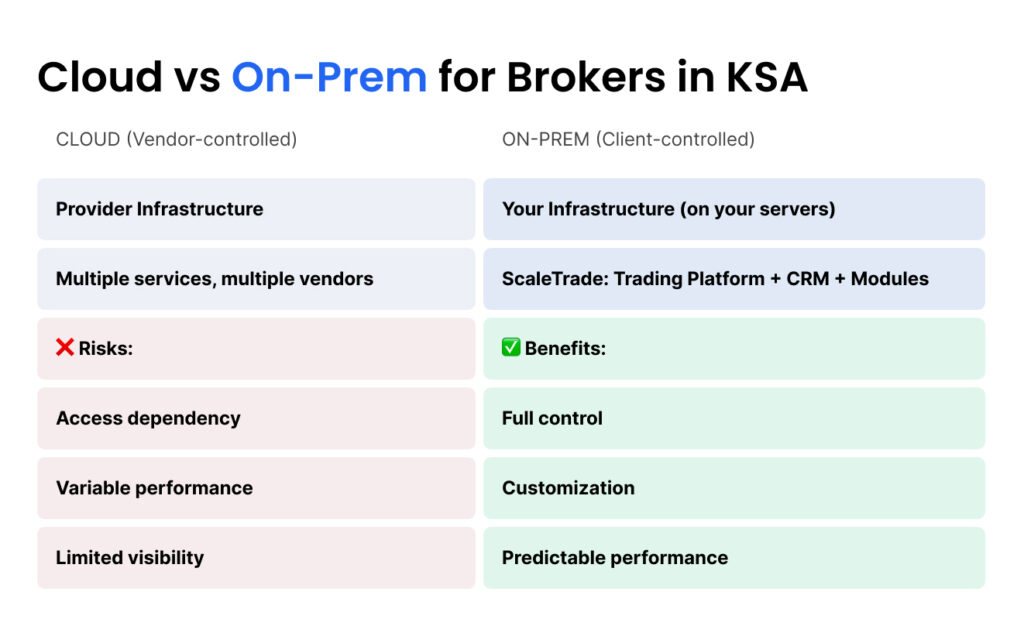
A typical broker needs a trading platform (web, mobile, desktop), CRM for client management and back-office, market data feeds, and specialized features like copy trading or algo tools. Stitching together separate cloud services means APIs, auth layers, data sync, and multiple failure points.
An integrated on-prem stack — like ScaleTrade’s White Label Solution — eliminates most integration seams. Components share data models, authentication, and operational workflows.
When your trading platform and CRM share the same database and access control, you don’t need middleware to sync client data. When your market data feeder is built to work with your order management system, you don’t debug API mismatches at 3 AM.
And because it’s on-prem, you optimize infrastructure for your needs: more memory for analytics, faster storage for tick data, network config for sub-millisecond routing.
Key Takeaways
- Cloud dependency creates operational risks that hit brokers harder than typical enterprise IT: vendor lock-in, performance variability, and data sovereignty challenges
- KSA regulatory frameworks from DFSA, FSRA, CMA, and central banks increasingly expect demonstrable control and auditability
- On-prem requires discipline — proper monitoring, tested DR, role-based access — not just hardware procurement
- Integrated infrastructure reduces complexity when components are designed to work together from day one
- The right choice depends on scale, compliance requirements, and internal technical capability
How ScaleTrade Helps
ScaleTrade provides complete white label brokerage infrastructure designed for on-premises deployment. Our integrated stack — ST Trading Platform (web, mobile, desktop), ST CRM, ST Feeder, and modules including Copy Trading and IB portals — runs on your infrastructure, giving you full control.
We handle the complex parts: building modern trading experiences, managing market data integration, providing operational tools that work together. You handle what matters to your business: clients, positioning, compliance.
Our approach emphasizes configuration over custom development, so you adapt the system to your requirements without expensive engineering projects.

Retail Leaders Circle MENA Summit Set To Welcome Key Dignitaries & Reveal Regional Research
SABIC REDUCES CARBON FOOTPRINT IN COLLABORATION WITH CHARGE AMPS THROUGH CERTIFIED RENEWABLE LEXAN™ POLYCARBONATE FOR ELECTRIC VEHICLE CHARGER HOUSINGS
 Email: info@cyber-gear.com